
One device at the panel, in front of everything
Whole-house surge protection in Rome, GA
Nearly everything in a house has a circuit board in it now: the HVAC, the water heater, the fridge, the garage door opener, the dimmers on the wall, even the breakers in newer panels. A whole-house surge protector is a small device wired into the electrical panel that stands in front of all of it, clamping voltage spikes down to a level electronics can survive. Georgia sits in one of the most lightning-active parts of the country, and a Rome summer delivers plenty of afternoons that prove it, but lightning is only part of the story. Most of the surges a house sees are small ones its own equipment makes every day, and they add up quietly. The device itself is modest. The reason it belongs in an electrician's hands is that installing it means opening a live panel.
When it makes sense to add one
- A house full of the usual modern equipment: an HVAC system with a control board, a newer fridge, a tankless water heater, anything you would hate to replace over one bad afternoon
- You have already lost something to a storm, a garage door opener, an HVAC board, a TV, which is usually the moment people call
- A panel upgrade or new service is happening anyway, since the electrical code now requires surge protection there and adding it during panel work is the cheapest it will ever be
- A standby generator or EV charger is going in, both of which are expensive electronics worth standing in front of
- A well pump or shop equipment on the property, because big motors make their own surges every time they cycle
- An existing surge protector with a dark indicator light, which means it has done its job and is no longer protecting anything
How the work goes
-
What the device actually does
The kind that goes in a panel is called a Type 2 surge protective device, and it works by giving excess voltage somewhere better to go. When a spike comes in from a nearby lightning strike, a utility switching event, or your own AC compressor kicking off, the protector shunts that energy to ground before it travels down the branch circuits. A power strip can only protect what is plugged into it. A panel unit sits where every circuit in the house begins, which is the only place one device can cover the hardwired equipment: the HVAC, the water heater, the oven, the well pump. None of those will ever plug into a strip.
-
The grounding gets checked first
A surge protector is only as good as the path it dumps energy into. Before one goes in, the grounding electrode system gets looked at: the ground rods, the clamps, the bonding. On some of the older housing stock around Rome that path has been loose, corroded, or missing pieces for decades, and correcting it is sometimes the most valuable part of the visit. A protector shunting to a bad ground is mostly decoration.
-
Mounted at the panel, on short leads
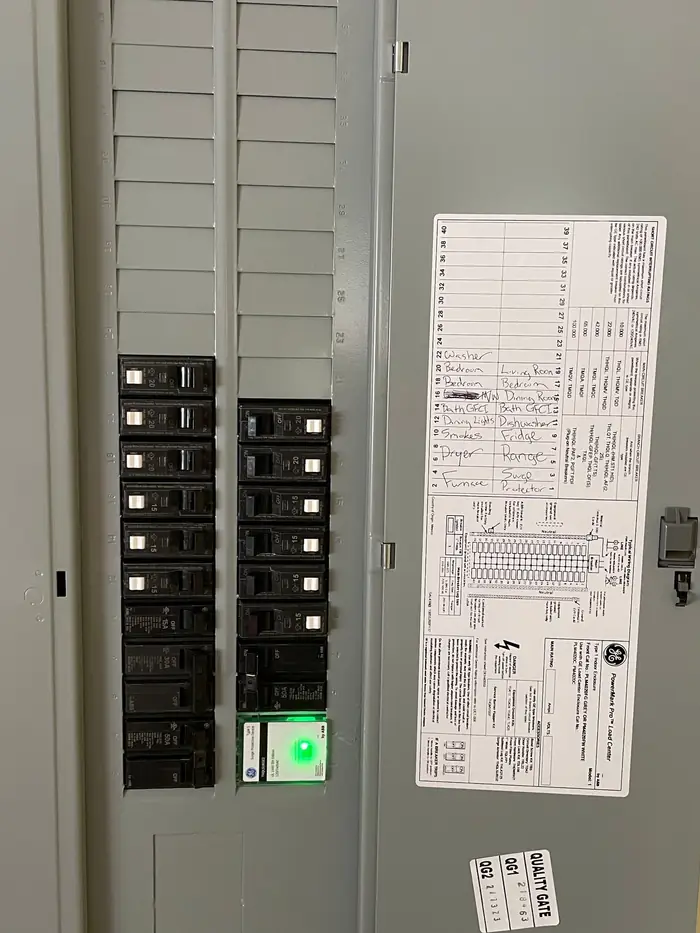
The unit lands on its own two-pole breaker, mounted at or beside the panel with the connecting leads kept as short and straight as the layout allows. That detail is not fussiness. Every extra inch of lead raises the voltage that gets through to your equipment before the protector clamps, so an install with a tidy, short run performs measurably better than the same device wired long and looped. It is the difference between a protector that meets its rating and one that only looks like it does.
-
Dead front off means licensed work
Installing one means removing the panel cover and working beside the service conductors, which stay energized even with the main breaker switched off. Georgia licenses electrical work at every job size for exactly this kind of task: small device, live panel, no margin for a guess. The work is done under the owner's Georgia electrical license, tested, labeled, and closed up the way a panel should look.
What moves the price
The device is the small part of the quote. The condition of the panel and the grounding decides the rest.
- The protector itself, since ratings vary and a large home with heavy loads justifies a stouter unit than a small ranch
- Whether the panel has two open spaces for the connection, or the breakers need rearranging to make room
- The state of the grounding system, because rods, clamps, or bonding that need correcting are real work
- Pairing it with a panel upgrade, which folds most of the labor into work already being done
- Adding point-of-use protection behind sensitive electronics if you want the second layer handled at the same visit
Send a photo of your panel with the door open and you will get a straight answer on what fits your service.
Where we stop, and why
A whole-house surge protector is insurance, not immortality. It clamps the everyday surges that quietly shorten the life of your equipment, and it takes the edge off a nearby lightning strike, but nothing bolted to a panel shrugs off a direct hit, and we will not tell you otherwise. Sensitive electronics like computers and TVs still deserve a good point-of-use protector as a second layer behind them. The panel unit is the one that stands in front of everything else, including all the equipment that can never be plugged into a strip. Like every service here, the install is electrical work done under the owner's Georgia license, which is the reason Journey Electric exists as its own trade alongside Journey Home Services.
What to expect on the day
The main breaker off and the panel cover removed, with the grounding and bonding inspected while it is open
The protector mounted and landed on its own two-pole breaker, leads kept short
Power back on, the status indicator verified, and a plain walkthrough of what that light means and when to glance at it
The panel closed, labeled, and anything found while it was open told to you straight
Whole-House Surge Protection questions
Are whole-house surge protectors worth it?
For most homes, yes, and the arithmetic is simple: count the circuit boards in your house, then compare the cost of the protector to replacing any single one of them. An HVAC control board alone usually costs more than the whole install. The part people miss is that the case for one is not really about lightning. Most surges are small internal ones from your own motors cycling, and they age electronics gradually, so equipment just seems to die young with no storm to blame. Where the value honestly drops: a home with very little electronic equipment, which in practice almost no longer exists.
Will it stop a direct lightning strike?
No, and be suspicious of anyone who says theirs will. A direct strike delivers more energy than any panel-mounted device is built to absorb, and that scenario is what homeowner's insurance is for. What a surge protector handles is everything short of that, which is nearly everything that actually happens: nearby strikes pushing spikes in through the lines, utility switching, power coming back on after an outage, and the daily surges your own equipment makes. If a bad storm is sitting on top of you and something is precious, unplugging it is still the one form of protection that cannot fail.
Do I still need surge strips behind the TV and computer?
For the sensitive stuff, yes. The two layers do different jobs. The panel unit takes the big hit first and clamps it down to a level that most equipment shrugs off, and a good point-of-use protector trims what remains for delicate electronics. The panel unit also covers everything a strip never can, because your HVAC, water heater, and oven do not plug into one. One thing worth knowing: cheap strips wear out silently and keep passing power after their protection is gone, so a strip old enough to be dusty is probably just an extension cord now.
How long does one last, and how do I know it is still working?
There is no fixed lifespan, because a surge protector spends itself. The components inside sacrifice a little of their capacity with every surge they absorb, and one severe event can use up a unit in an afternoon. That is by design: better the protector than your equipment. Every unit we install has a status indicator on the front, and the habit worth building is a glance at it after any big storm. Lit means protected. Dark means it has done its job and is now protecting nothing, and it is time to replace it.
Is surge protection required by code?
On new and replaced services, yes. Since the 2020 National Electrical Code, which Georgia uses, every new dwelling service and every service equipment replacement has to include a Type 1 or Type 2 surge protective device. Nobody is forced to retrofit an existing home, so if your panel is older, adding one is your choice rather than an obligation. But the code change tells you which way the industry read the evidence: houses are full of electronics now, and the code treats protecting them as basic rather than optional. When we replace a panel, the protector is part of that job.
Can I install one myself?
The box makes it look like a twenty-minute job, and the mechanical part almost is. The problem is where the work happens. Installing one means taking the dead front off the panel and working beside the service conductors, and those stay live even with the main breaker off, because they are fed from the utility side. Georgia licenses electrical work at any job size for that reason, with no small-job exemption. The install details also decide whether the unit performs: lead length and the condition of the grounding are the difference between rated protection and a plastic box with a light on it.
Where we do this work
Whole-House Surge Protection across Rome, Floyd County and the towns around them in Northwest Georgia, including 6 distinct parts of Rome, from Between the Rivers to the newest streets off US 27.That is Floyd, Polk, Gordon and Bartow counties, and the towns listed below.
Town by town, that means Acworth, Adairsville, Aragon, Armuchee, Braswell, Buchanan, Calhoun, Cartersville, Cave Spring, Cedartown, Coosa, Dallas, Emerson, Euharlee, Fairmount, Hiram, Kingston, LaFayette, Lindale, Lyerly, Menlo, Plainville, Ranger, Resaca, Rockmart, Rome, Shannon, Summerville, Taylorsville, Trion and White. Each has a page on what its houses actually need, and smaller places in those counties are covered too. The full picture.
Recent work
Surge Protection we have finished
Our own photographs, taken on the job.
Often booked together
Related work
These come up alongside surge protection often enough to be worth mentioning when you call.
Panel Upgrades & Breaker Box Replacement
Honest panel verdicts, Federal Pacific and Zinsco replacements, and 200-amp upgrades for houses that outgrew their service.
What's involvedGenerator Installation
Standby systems sized by real load, and the inlet and interlock that make a portable generator legal.
What's involvedNeed surge protection in Rome?
Tell us what you have lost to storms, if anything, and send a photo of your panel with the door open. That is enough for a straight answer on what fits your service.