
The switching matters as much as the generator
Generator installation in Rome, GA
There are two honest ways to keep a house running when the power drops, and they are priced worlds apart. A standby generator sits on a pad outside, watches the utility line, and starts itself when the line fails, so the fridge barely notices. A portable generator with an inlet and an interlock kit costs a fraction of that and keeps the essentials on for the effort of walking outside and pulling a cord. We install both, and we'll tell you plainly which one your situation actually justifies. What the two lanes share is the changeover gear: the switching that connects your house to the generator and disconnects it from the grid. In Georgia that part is licensed electrical work at any size, and it is the part this page takes most seriously, because a mistake there reaches past your own property line. Done wrong, it can put power on lines a utility crew believes are dead.
When this is the right call
- A standby system for a house that can't sit dark: medical equipment, remote work, a well pump, or freezers full of what your family eats
- A portable generator you already own, and the inlet and interlock that let it feed the panel legally instead of through window cords
- Deciding between whole-house coverage and essential circuits before spending standby money
- A transfer switch or interlock sized to a new portable and to the panel it lands on
- A hookup you inherited with the house that nobody can explain, especially anything involving a cord with two male ends
- A generator that came with the house, where nobody knows whether the transfer gear actually works
How a generator install goes
-
Sizing starts with a load calculation, not square footage
Two houses the same size can need very different generators. What matters is what has to run at the same time: the heat source, a well pump, refrigeration, and above all what starts, because a compressor draws several times its running current in the moment it fires. We do the arithmetic on your actual panel and your actual appliances. The honest answer is often smaller and cheaper than the brochure number, especially with load management, which staggers the big motors so they never start together.
-
The transfer switch is where the safety lives
A standby system uses an automatic transfer switch: it senses the outage, starts the generator, moves the house over, then reverses everything when the line returns. A portable lane uses an interlock or a manual switch instead. Every version exists to enforce one rule, that the house can never be connected to both sources at once. That rule is the whole reason Georgia treats changeover gear as licensed electrical work no matter how small the job is.
-
Fuel is its own trade, and we coordinate it
A standby unit runs on natural gas or propane, and it is hungrier than any appliance in the house. Meters often need upsizing and gas lines have to be sized for the demand at that distance, which is work that belongs to the gas trade. We plan it into the job and schedule around it rather than leaving you to referee two contractors. A generator starved for fuel pressure runs rough, sheds load at the worst moment, and shortens its own life.
-
Siting is exhaust, code, and neighbors
The pad location has to satisfy the unit's listing: far enough from windows, doors and vents that exhaust can't find its way indoors, clear enough for service access, level, and ideally not under the bedroom window, because these machines are not quiet. Getting the spot right on paper before anything is poured is much cheaper than moving a several-hundred-pound machine after the inspector or your spouse objects.
-
The portable lane gets the same seriousness
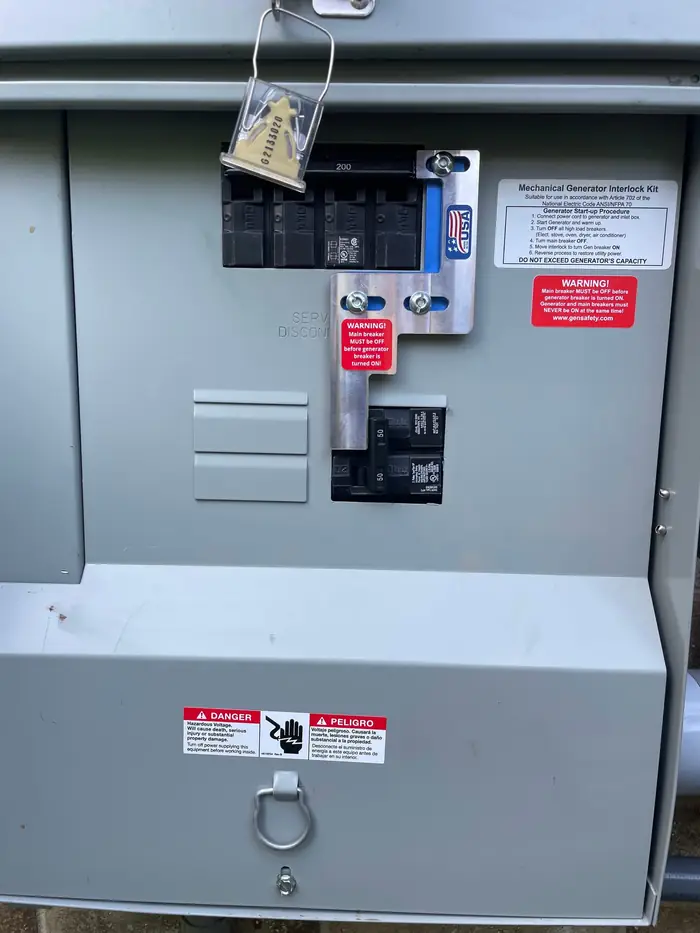
An inlet box outside, a backfeed breaker, and an interlock kit listed for your exact panel make and model. That listing matters: a generic slide that almost fits is exactly the kind of thing an inspection exists to catch. Where an interlock doesn't suit the panel, a manual transfer switch with a handful of chosen circuits does the same job a different way. Either way it's usually a single visit, and in an outage your part is a cord, a pull start, and a few breakers.
-
Tested under load before it's yours
No generator job ends at installed. A standby system gets a simulated outage: utility side opened, the unit starts, the house transfers, real loads run, and the retransfer happens on its own. On portable setups you run the drill yourself while we watch, so the first real outage is not your first attempt. You also get the plain-English version of the controller, the weekly self-test, and what to look at after a long run.
Why generator quotes swing so widely
Generator quotes swing more than almost anything else in this trade, because the two lanes are different jobs entirely. Here is what actually moves the number.
- Which lane: a standby system is a multi-trade installation, an inlet and interlock is usually one visit
- Generator size, which falls out of the load calculation and the whole-house versus essentials decision
- The run from the pad to the panel and to the fuel source, since conductor length and trenching are real cost
- The panel itself: whether a listed interlock exists for it, whether there is space for the backfeed breaker, or whether panel work has to come first
- Fuel: natural gas at an existing meter versus a propane tank that has to be sized and set
- Site work: the pad, grading, and how far the unit must sit from openings
Tell us what has to stay on in an outage and send photos of your panel and your meter area. That usually settles which lane fits before anyone spends anything.
Where we stop, and why
Everything from the inlet or transfer switch to the panel is electrical work done under Tanner Regennitter's Georgia electrical license, and Georgia requires that license at any job size: there is no small-generator exemption. The gas side belongs to the gas trade, and we coordinate it rather than dabble in it. The incidental work a generator job turns up, like siding repaired around a new inlet box, is carpentry rather than electrical, and our sister company Journey Home Services covers it.
What to expect on install day
A settled plan first: which lane, what size, where the unit or inlet goes, and what the gas trade will handle, agreed before work starts
Power off for part of the day while the transfer gear ties into the panel, with enough warning to plan around it
On standby jobs: the unit set on its pad, the transfer switch mounted and wired, control wiring run, and the fuel connection completed by the gas trade
On portable setups: the inlet mounted, the backfeed breaker and interlock installed, and a cord matched to the inlet's rating
A transfer test under real load before the job is called done, with you doing the switching on portable setups
The permit inspection scheduled as part of the work, not left as your homework
Generator Installation questions
What size generator does my house actually need?
Not a square-footage answer. Two houses the same size can need very different machines depending on what has to run: electric heat versus gas, a well pump, how much refrigeration. The number that matters most is starting load. A central AC compressor draws several times its running current in the moment it starts, and that spike is what stalls an undersized generator. We do a load calculation on your actual panel, and the result is often smaller than the rule-of-thumb number, especially with load management, which keeps the two biggest motors from ever starting in the same instant.
Can I just backfeed a dryer outlet with a double-male cord?
No, and this one deserves the why. Electricians call that a suicide cord, and the name is earned twice over. First, the moment one end is plugged in, the other end is a set of live exposed prongs in your hand. Second, with the main breaker closed, your generator feeds backward through the same transformer that normally steps utility voltage down to your house. Running in reverse, it steps your 240 volts up into the thousands and puts it on lines a utility crew has every reason to believe are dead. Linemen have been killed exactly this way. It ends badly at home too: when utility power returns, it meets your generator head-on and usually wrecks it. An interlock or transfer switch removes every one of those failure modes, which is the entire reason the changeover gear exists.
Transfer switch or interlock kit: what's the difference?
An interlock kit is a sliding plate on your existing panel that makes it mechanically impossible to turn on the generator's backfeed breaker until the main is off. Paired with an outdoor inlet, it lets a portable feed the whole panel, and you choose what runs by flipping breakers. It's the least expensive legal hookup, but it must be a kit listed for your exact panel model, and the switching is yours to do by hand. A manual transfer switch is a small separate panel holding a handful of chosen circuits: less flexible, very simple in the dark. An automatic transfer switch is what a standby system uses, sensing the outage and moving the house over on its own. Which one fits is mostly budget and how much you want to be doing at midnight in the rain.
Do I really need a licensed electrician and a permit for this in Georgia?
Yes. Georgia licenses electrical work at any job size, and there is no exemption for generators or interlock kits. The reason the rule bites hard here is that this is the one piece of house wiring that can hurt someone outside your property line. The changeover gear is what guarantees your generator can never energize the utility's lines, and the permit inspection is a second set of eyes on exactly that, plus the siting and clearances on a standby unit. As permit fees go, that one buys something real.
Natural gas or propane for a standby generator?
Usually whichever your house already has. On natural gas the generator runs as long as the utility keeps supplying it, no tank to watch, though the meter and line often need upsizing for the extra demand, which the gas company or a gas contractor handles. On propane, runtime is your tank: bigger buys longer outages, and the tank has to be sized for a generator's appetite, which is larger than a furnace's. Neither choice is wrong, and it mostly comes down to whether there's a gas meter on the wall already. Portables are simpler: most burn gasoline, and the practical limit is how much fuel you can safely store and how often you're willing to refill mid-outage.
I already own a portable generator. What do I need to run it safely?
Three things on our side: an inlet box outside, a backfeed breaker, and an interlock or transfer switch so the house can never see the generator and the grid at once. That's usually one visit. Your side is placement, and this is the part that kills people every storm season: run it outdoors only, at least twenty feet from the house with the exhaust pointed away, never in a garage, carport, basement or under an open window, even with doors open. Carbon monoxide from a generator can build to lethal levels indoors fast, so working CO alarms in the house are part of the setup, not an extra. Use a cord rated for the inlet, not a daisy chain of light-duty extension cords, and you have a system that will carry you through an outage without drama.
Where we do this work
Generator Installation across Rome, Floyd County and the towns around them in Northwest Georgia, including 6 distinct parts of Rome, from Between the Rivers to the newest streets off US 27.That is Floyd, Polk, Gordon and Bartow counties, and the towns listed below.
Town by town, that means Acworth, Adairsville, Aragon, Armuchee, Braswell, Buchanan, Calhoun, Cartersville, Cave Spring, Cedartown, Coosa, Dallas, Emerson, Euharlee, Fairmount, Hiram, Kingston, LaFayette, Lindale, Lyerly, Menlo, Plainville, Ranger, Resaca, Rockmart, Rome, Shannon, Summerville, Taylorsville, Trion and White. Each has a page on what its houses actually need, and smaller places in those counties are covered too. The full picture.
Recent work
Generators we have finished
Our own photographs, taken on the job.
Often booked together
Related work
These come up alongside generators often enough to be worth mentioning when you call.
Panel Upgrades & Breaker Box Replacement
Honest panel verdicts, Federal Pacific and Zinsco replacements, and 200-amp upgrades for houses that outgrew their service.
What's involvedWhole-House Surge Protection
A surge protector wired into your panel that clamps voltage spikes before they reach anything with a circuit board.
What's involvedElectrical Inspections & Older-Home Wiring
Pre-purchase and insurance inspections, aluminum and knob and tube answers, and rewiring scoped to what is actually wrong.
What's involvedNeed generators in Rome?
Say which lane you're leaning toward, list what has to stay on when the power drops, and send photos of your panel and meter area. That's enough for a straight answer on what fits your house.